


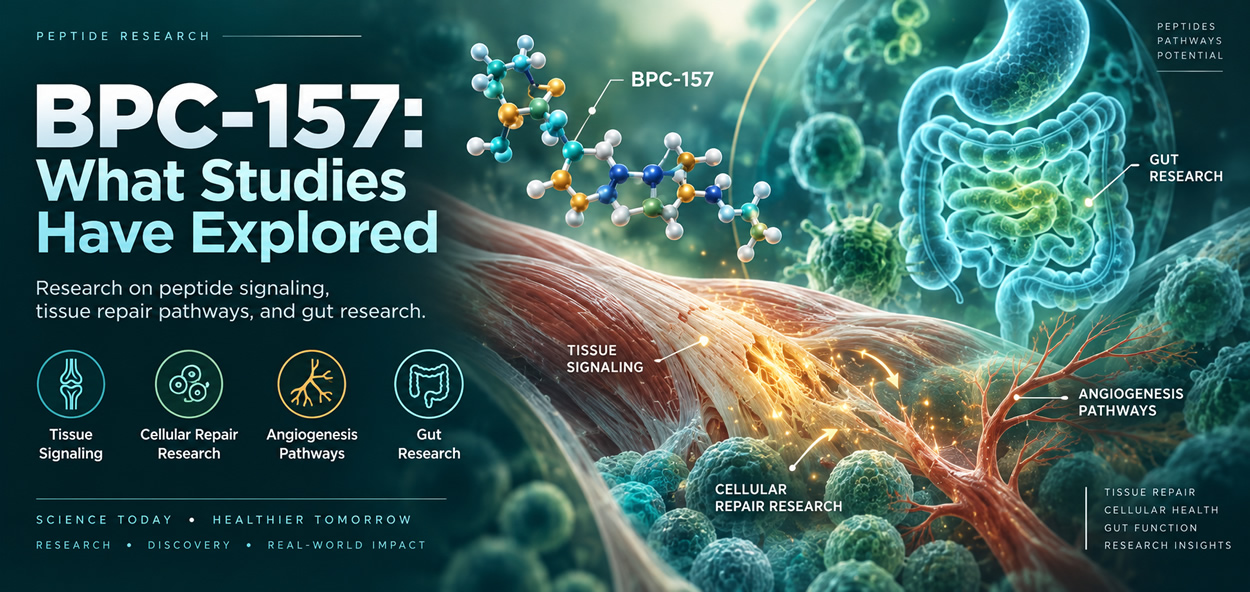
BPC-157 is a synthetic 15-amino-acid peptide studied primarily in preclinical research for its effects on tissue repair, tendon recovery, blood vessel signaling, and gastrointestinal tissue.
Much of the scientific interest surrounding BPC-157 comes from animal and laboratory research examining how it interacts with biological processes involved in healing and tissue protection. Studies have explored its effects in tendons, muscles, the digestive system, blood vessels, nerves, and other tissues.
Unlike compounds with large clinical research programs, however, BPC-157 still has very limited human data. Most of what researchers currently know comes from preclinical studies rather than controlled human trials.
What Has BPC-157 Research Studied?
Research on BPC-157 spans several areas involving tissue protection, repair, and recovery.
- Tendon and ligament research: Animal studies have examined BPC-157 in models of tendon injury, including Achilles tendon damage and tendon-to-bone healing.
- Muscle repair: Researchers have studied its effects following muscle injury and examined pathways associated with tissue regeneration.
- Blood vessel signaling: Laboratory and animal research suggests BPC-157 may influence angiogenesis, endothelial function, and signaling involved in the formation and repair of blood vessels.
- Gastrointestinal tissue: Some of the earliest BPC-157 research examined stomach and intestinal tissue, ulcers, inflammation, and gastrointestinal injury.
- Nerve and neurological research: Animal studies have explored peripheral nerve injury, spinal cord injury, and other neurological models.
What Has Research Found About Tendons?
Tendon healing is one of the most frequently discussed areas of BPC-157 research.
Animal studies involving injured Achilles tendons have reported changes in tendon organization, functional recovery, and mechanical strength during healing.
Laboratory research involving tendon cells has also examined interactions between BPC-157 and growth-related signaling pathways. Some studies suggest that BPC-157 may influence how tendon cells respond to growth hormone and other signals involved in tissue repair.
These findings have made musculoskeletal recovery an important area of continued BPC-157 research.
BPC-157 and Blood Vessel Research
Healthy tissue repair depends heavily on blood flow. New and recovering tissue requires oxygen, nutrients, and functioning blood vessels.
Preclinical research suggests BPC-157 may influence several processes related to blood vessel function, including endothelial signaling and angiogenesis, the formation of new blood vessels.
Researchers have also investigated its interaction with nitric oxide pathways, which play an important role in regulating blood vessel tone and circulation.
These vascular effects may help explain why BPC-157 has been studied across several different types of injured tissue rather than within one specific organ system.
What Has Research Found About the Digestive System?
The gastrointestinal system has been a major focus of BPC-157 research for decades.
Animal studies have examined BPC-157 in models involving stomach ulcers, intestinal injury, inflammatory changes, and damage to the gastrointestinal lining.
Researchers have reported effects involving tissue protection, blood vessel function, and healing responses within the digestive tract.
This body of research is one reason BPC-157 is often studied as a broader tissue-protective peptide rather than solely as a musculoskeletal compound.
What Has Research Found About Nerves and the Nervous System?
Researchers have also investigated BPC-157 in animal models involving peripheral nerves, spinal cord injury, and neurological damage.
Some studies have reported improvements in functional recovery and changes in tissue repair following experimental nerve injuries.
This research remains preclinical, but it has broadened scientific interest in BPC-157 beyond tendons, muscles, and gastrointestinal tissue.
What Human Research Exists?
Human research on BPC-157 remains extremely limited compared with the amount of animal and laboratory research available.
A 2026 review of the scientific literature identified three published human studies involving fewer than 30 participants in total. These included research involving chronic knee pain, interstitial cystitis, and a small pharmacokinetic and safety study.
None of these published studies was a large randomized, placebo-controlled clinical trial, which limits the conclusions that can be drawn from their results.
Controlled human research is beginning to expand. A randomized, double-blind, placebo-controlled Phase 2 study began recruiting participants in 2026 to examine BPC-157 in adults with acute grade II hamstring muscle strains.
The study is designed to evaluate measures including return to unrestricted sports activity, changes in injury size measured by MRI, pain, muscle strength, and physical function.
What Has Safety Research Reported?
Because human exposure has been studied in relatively few participants, the human safety profile of BPC-157 is not yet well characterized.
Preclinical studies have generally not identified consistent patterns of organ toxicity under the conditions studied, but findings from animal research cannot establish a complete human safety profile.
The small published human studies have not reported major safety signals, although their limited size means they would be unlikely to identify uncommon or long-term effects.
A 2025 human pharmacokinetic pilot involved only two participants. Researchers reported no adverse events in those participants and observed a plasma half-life of less than 30 minutes. The extremely small study size means the findings are primarily useful for early pharmacokinetic research rather than broad conclusions about safety.
Larger controlled clinical studies will be needed to better characterize pharmacokinetics, biological activity, and short- and long-term safety in humans.
How Does BPC-157 Compare With TB-500?
| Compound | Research Focus | Current Evidence Base |
|---|---|---|
| BPC-157 | Tendons, gastrointestinal tissue, blood vessel signaling, muscle, nerves, and tissue repair | Extensive preclinical research with very limited published human data |
| TB-500 | Soft tissue, cell movement, blood vessel formation, wound repair, and recovery research | Research is primarily preclinical and related to thymosin beta-4 biology |
BPC-157 and TB-500 are frequently discussed together because their research areas overlap, particularly in tissue repair, blood vessel formation, and recovery.
Their biological origins and proposed mechanisms differ. BPC-157 research spans a particularly broad range of tissues, including the gastrointestinal and nervous systems, while research related to TB-500 and thymosin beta-4 has focused heavily on cell migration, actin regulation, wound repair, and soft tissue.
Because the human evidence for both compounds remains limited, comparisons are based largely on laboratory and animal research rather than large head-to-head clinical studies.
Why Is BPC-157 of Research Interest?
BPC-157 continues to attract scientific interest because preclinical studies have reported biological activity across an unusually broad range of tissues.
Research has explored tendon and muscle recovery, gastrointestinal tissue, blood vessel signaling, inflammation, nerve injury, and other processes involved in tissue protection and repair.
At the same time, the large difference between the amount of preclinical research and the small amount of human research remains important. The addition of controlled Phase 2 research may begin to provide stronger evidence about whether findings observed in laboratory and animal models also occur in people.
Research Sources
- 2026 reviews of BPC-157 preclinical and human research
- Clinical studies examining BPC-157 in chronic knee pain and interstitial cystitis
- Human pharmacokinetic and safety pilot research
- Animal studies examining tendon, muscle, gastrointestinal, vascular, and nerve repair
- ClinicalTrials.gov Phase 2 hamstring muscle strain research
- Research examining BPC-157 signaling and tissue-protective mechanisms